Showing posts with label The Berkshires. Show all posts

10 November 2014

A Visit to the Mount


On my recent trip to the Berkshires, I was able to spend a day at the Mount, Edith Wharton’s former home in Lenox, Massachusetts. I had been once before, years ago when the Mount was still being worked on, and was eager to see the home and gardens fully restored.

Author of more than 40 books and the first woman to win the Pulitzer Prize for literature (1921), Edith Wharton was also a keen interior designer and gardener. Her first book was actually about design, The Decoration of Houses, which she co-wrote with architect Ogden Codman, Jr. in 1897.

When she and her husband, Teddy, purchased 113 acres of land in Lenox for $40,600 in 1901, she decided to design and build a house based on the principals of her book. Recruiting Codman and Francis L.V. Hoppin as architects and R.W. Curry as builder, Wharton conceived of a home with classical Italian and French influences and none of the heavy, Victorian excesses popular at the time. Finished in the fall of 1902, the Mount would be Wharton’s home for the next ten years and her last address before leaving Teddy and America to live in France.

The walk up to the entrance of the Mount. Photos by Michele.

Turning down the unfortunately named Plunkett Street, we parked near the front of the estate where the gatehouse and stables are located. A quarter-mile walk down a maple-lined drive brings you to the entrance of The Mount, which actually appears to be at the side of the house. You can go inside for a tour but we chose to explore the grounds first before the rain became too heavy.

Continuing past the house, you come to an Italian walled garden with its arched walls and rock-pile fountain. Wharton called this her giardino segreto or secret garden. Steps lead up to a lime walk that runs behind the house, which makes you feel as if you've stepped into the past and are on the grounds of a French castle. Looking up, you find the back of the Mount with its wide terrace and distinct green and white striped awnings.


At the end of the Lime Walk is the French flower garden with its dolphin fountain. Wharton originally planted the garden with hollyhocks, phlox, snapdragons, and stocks, among others. Many of these same flowers are planted today, and we were fortunate to still find some blooms even late in the season. 

Looking out beyond the gardens the lawn slopes down to the trees and a small body of water courtesy of the some busy local beavers. To step out onto the terrace and look down onto the gardens and the trees beyond would never get old.

Leaving the flower garden and walking down a path in the woods we came around to the other side of the house and a small rise on which one finds a small cemetery where Wharton's dogs are buried. Wharton loved her dogs and was often photographed with them. Here lies Modele, Mimi, Miza, Jules, and Toto too. We discovered afterwards that Wharton had a view of the cemetery from her bedroom window.


The Gallery. Photo by Michele.

Looking down the long Drawing Room. Photo by Michele.

Back at the house, we decided to take the guided tour, which begins in the entrance hall created to resemble a grotto. Here visitors would wait to see if Mrs. Wharton was entertaining people (she famously disliked large parties; no surprise then that the Mount only has two guest rooms). If she was, the visitors were often greeted by their hostess bearing champagne. 

Side note, I was told when entering the house that I could take photos with my camera but no flash. No problem. I was shooting with my camera when I decided to take a quick shot with my phone so I could post an image on Instagram. My phone was dead. The guide noticed and said that it happens all the time, and they think it's the ghosts acting up. Later, when we stopped somewhere in town, I plugged my phone in to find it charged at 50%. Ghosts? 

Anyways, the tour continued through the rooms on the main floor, which include the Gallery where the Whartons displayed treasures from their travels; Teddy's Den; the Drawing Room, which reminded me of sitting rooms at Holyrood Palace in Edinburgh; and the Dining Room where a jar with dog treats sits on the table, ready for one of Wharton's little friends.The library is also on this floor with oak panelling and shelves filled with books from Wharton's personal collection. It was a room where Wharton liked to engage in conversation with close friends like Henry James not, contrary to her publicity photos, where she wrote (she did that in her bedroom). 


A distinctly modern touch to the staircase. Photo by Michele.

The bathroom has its original tub and wallpaper. Photo by Michele.


It should be noted that when Wharton moved to France, she emptied the house of its belongings. When the Mount was restored, a select group of interior designers were invited to reinterpret a room, keeping Wharton's ideas in mind. This accounts for why the furniture is not original to the house and why there are some decidedly modern elements to be found like the leopard print carpeting on the staircases. 

Upstairs on the bedroom level is the West Guest Suite, the Henry James Suite (the room with the best view), Teddy's Suite, and Wharton's Suite, which is comprised of her bathroom,  bedroom, and boudoir (or sitting room). It was here in her bed that Wharton would write every morning, flinging each page to the floor for her secretary to collect and type up. Her boudoir next door, the most elaborate of all the rooms on this floor, acted as her office and the current furniture in the room mimics what was originally in the room including a table and chair, and chaise lounge by the window. 

It was at the Mount that the Whartons' marriage finally disintegrated. Although it was long and unpleasant, Wharton managed to write some of her best material during this time including Ethan Frome and my personal favourite, The House of Mirth. I like to think that that the house helped, giving her the space and quiet that she needed to work. 

Back down two flights to the ground floor is where you find the Kitchen, Scullery, and Laundry Room. The Whartons were good employees and made sure that their longtime cook, Mary Bagley, and staff were equipped with the latest gadgets. And speaking of staff, there were other small rooms in the house, including on the bedroom floor, where servants either did work (like sewing) or had their own bedrooms.

After finishing the tour we got a cup of much needed hot tea and sat outside on the terrace admiring the view. Such a lovely home and gardens. I can't wait to visit again, perhaps in the spring to see all the flowers in bloom. Until then, I'll just have to read some Edith Wharton.

For more information about the Mount, visit their website here.

05 November 2014

Berkshires Getaway


The Massachusetts Museum of Contemporary Art (MASS MoCA). Photo by Michele.

Last month, I escaped New York for a few days to meet up with some friends in the Berkshires. Having lived in New England for many years, going back to Massachusetts always feels like going home. And what better time to visit than the fall?

In addition to hanging out and catching up, we wanted to see some art. Which is why we chose to stay in North Adams. It may be the smallest city in Massachusetts (population 13,708) but it has one huge collection of art. This former mill town, once known as a producer of textiles in the 19th century and electrical components in the 20th, is now a destination for contemporary art fans thanks to the opening of the Massachusetts Museum of Contemporary Art (MASS MoCA) in the old Arnold Print Works complex.


The Porches Inn, its view obscured by the seemingly endless amount of overhead wires in North Adams.
A partial view of our suite and Sabine, the Porches cat. Photos by Michele.

We stayed at The Porches Inn, located directly across the street from the MASS MoCA campus. A series of row houses originally used to house factory workers, they’ve been converted into a lovely hotel; each building features a porch with rocking chairs (hence the name) and charming rooms. To be honest, I could have just stayed at the hotel all day and been happy. Breakfast every morning consisted of local treats including Berkshire blend coffee and delicious sourdough bread, and in the evenings guests were welcome to enjoy a drink by the fire, which was much appreciated after being out in the cold. And if you were lucky, the Porches’ resident cat, Sabine, would make an appearance.


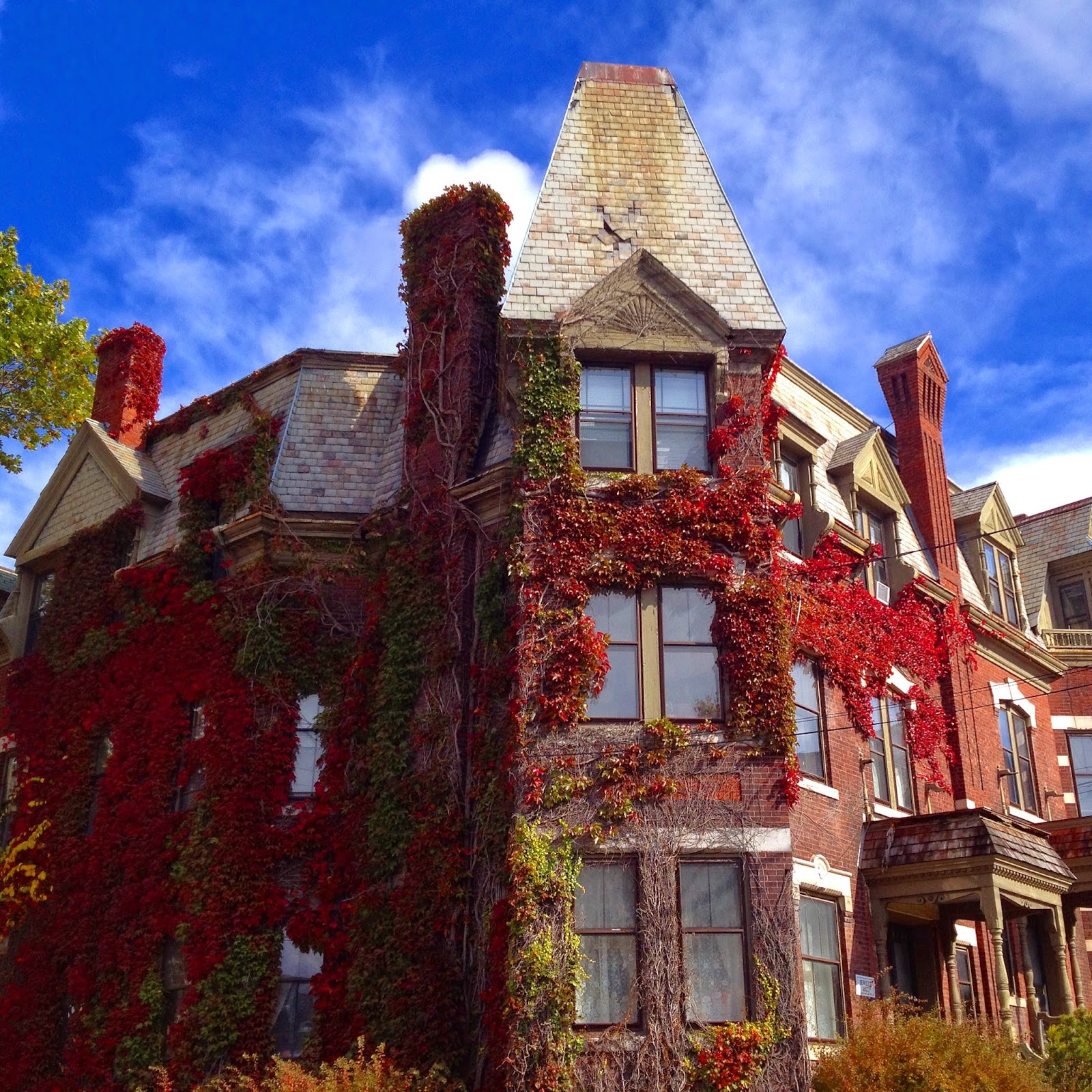
The Jewett House (i.e. perfect haunted house) built in 1872. Photo by Michele.

The North Adams Public Library. Photo by Michele.

 A ghost sign on a building in downtown North Adams for Enna Jettick shoes for women. Sizes 1-12, $5-$6. Photo by Michele.

"Bus Stand" by Victoria Palermo (2012). Photo by Michele


Even the signage on the local buildings has a certain artistic flair. Photos by Michele.

North Adams has a small downtown area with some lovely Victorian buildings like the Jewett House built in 1872 (wouldn’t it make the best ghost house?) and the Blackinton Mansion built in 1867 and now home to the North Adams Public Library. These 19th-century designs are juxtaposed with modern art installations, some of which serve a practical purpose. For example, “Bus Stand” by Victoria Palermo is both a piece of public art and an actual bus stand. I would also argue that some of the signage found around town constitutes an art form all its own.


The Mohawk Theatre, which first opened in 1938. Photos by Michele.

One of the most striking buildings in downtown North Adams is the old Mohawk Theater, which first opened its doors on November 5, 1938 (the feature film that day was That Certain Age with Deanna Durbin). A 1,200-seat movie theatre,it was an art deco jewel of its time. After it closed in 1991, the theatre fell into disrepair but locals fought plans to tear the Mohawk down and money was raised to restore the theater’s marquee. There is a campaign currently underway for restoration of the rest of the theatre.

Some of the different sites on the MASS MoCA campus. Photos by Michele.

Yet without a doubt the biggest draw in North Adams is Mass MoCA. With 110,000 square feet of exhibition space and 13-acres of property, it’s one of the largest contemporary art museums in the country with a campus as interesting as the art itself. The old brick factory buildings, bridges, and the Hoosic River cutting through the campus serve as a reminder that this was once a place of industry, starting before the Revolutionary War. What's so striking is how the surrounding modern art installations manage to blend right in with its 19th-century industrial setting.

 Examples from the Sol Le Witt "A Wall Drawing Retrospective" including signs telling visitors not to touch the walls. Photos by Michele.


 A detail from "Dance Dance Dance" by Dike Blair (2011). Photo by Michele.

 "Filthy Lucre" by Darren Waterston (2013-14). Photos by Michele.

We spent a whole day at MASS MoCA, and I’m pretty sure we didn’t see everything. What we did manage to catch was Sol LeWitt’s "A Wall Drawing Retrospective," 105 of LeWitt’s large-scale wall drawings, which will be on display at MASS MoCA for 25 years; "The Dying of the Light: Film as Medium and Metaphor," which showcases the work of six artists who create art with analog film; Mark Dion’s "The Octagon Room," an actual room filled with his personal belongings; “In Transit: Between Image and Object,” shipping crates that are turned into works of art by three artists; and “Filthy Lucre,” Darren Waterston’s stunning and somewhat unsettling re-imagination of James McNeill Whistler’s famed “Harmony in Blue and Gold: The Peacock Room.” 

Clockwise from left, "Lunar (Theatre)" (2014); "Black Sun" (2014); and "Scroll 1" from the "Golden series" (2013-14), which measures 108 inches wide and only 12 inches high. All by Teresita Fernández. Photos by Michele.

One of my favourite exhibits was “As Above So Below,” a wonderful collection of works by Teresita Fernández who turns common materials into something beautiful like the “Black Sun” (2014), which utilizes a collection of polycarbonate tubes to create a cloud of colour. And then there was “Lunar” (2014). For this piece, Fernandez covered a platform with 1,500 pounds of small glass beads that gave the appearance of snow.


 Scenes from Lee Boroson's "Moisture Content" (2014). Photos by Michele.

And my vote for most fun exhibit was Lee Boroson’s “Moisture Content” (2014). Don’t be discouraged by the title. Row upon row of hanging plastic orbs lead to a large round curtain that upon entering reveals to have more layers of material and flowers; it reminded me of a wedding dress. And judging by the antics of my fellow visitors, it has to be one of the museum’s top spots for taking selfies. 

MASS MoCA is a wonderful museum that one could probably spend a couple days at to see everything. It’s also hard on the feet, which is why it was nice to enjoy a great meal at the Gramercy Bistro on the campus that evening (and speaking of restaurants, need to mention another North Adams spot, PUBLIC eat+drink, who had amazing bourbon bramble cocktails).

The Williams College campus. Photo by Michele.

Our Berkshires trip wasn't confined to just North Adams. One afternoon we drove over to Williamstown to walk around the picture perfect Williams College campus and grab some coffee. And our last day was my favourite, a trip to Lenox to visit The Mount, Edith Wharton's home. More about that in my next post.

To find out more about MASS MoCA, visit their site here.

LinkWithin

Related Posts Plugin for WordPress, Blogger...