Showing posts with label Museum. Show all posts

08 February 2015

Night at the Museum


One of my favourite books when I was a little girl was From the Mixed Up Files of Mrs. Basil E. Frankweiler, the story of siblings Claudia and Jamie Kincaid who run away to live at the Metropolitan Museum of Art. Monday night I was able to experience my own version of sorts when I attended an after-hours Instameet at the museum sponsored by the Met and Bloomberg Philanthropies.

The evening began with cocktails and a chance to meet some fellow instagrammers. After that we were given a tour of the museum by the Met’s Chief Digital Officer Sree Sreenivasan. He was a perfect guide, pointing out some of his favourite pieces and relaying amusing anecdotes about various works. Everywhere we went cameras snapped away, capturing the art, selfies, and each other. There was even a group photo taken in the American Wing Courtyard of everyone lying on the ground.

 "Colossal Seated Statue of Amenhotep III, Reinscribed by Merneptah" (ca. 1390–1353 B.C.). Photo by Michele.

"The Temple of Dendur" (completed by 10 B.C.). Photo by Michele.

"The American Wing Courtyard." Photo by Michele
"Nydia, the Blind Flower Girl of Pompeii" Randolph Rogers (carved 1959). Photo by Michele.


"Adam" Tullio Lombardo (ca. 1490-95). Take a good look. Once he's placed 
in his new niche later this year, you'll only get a front view. Photo by Michele.

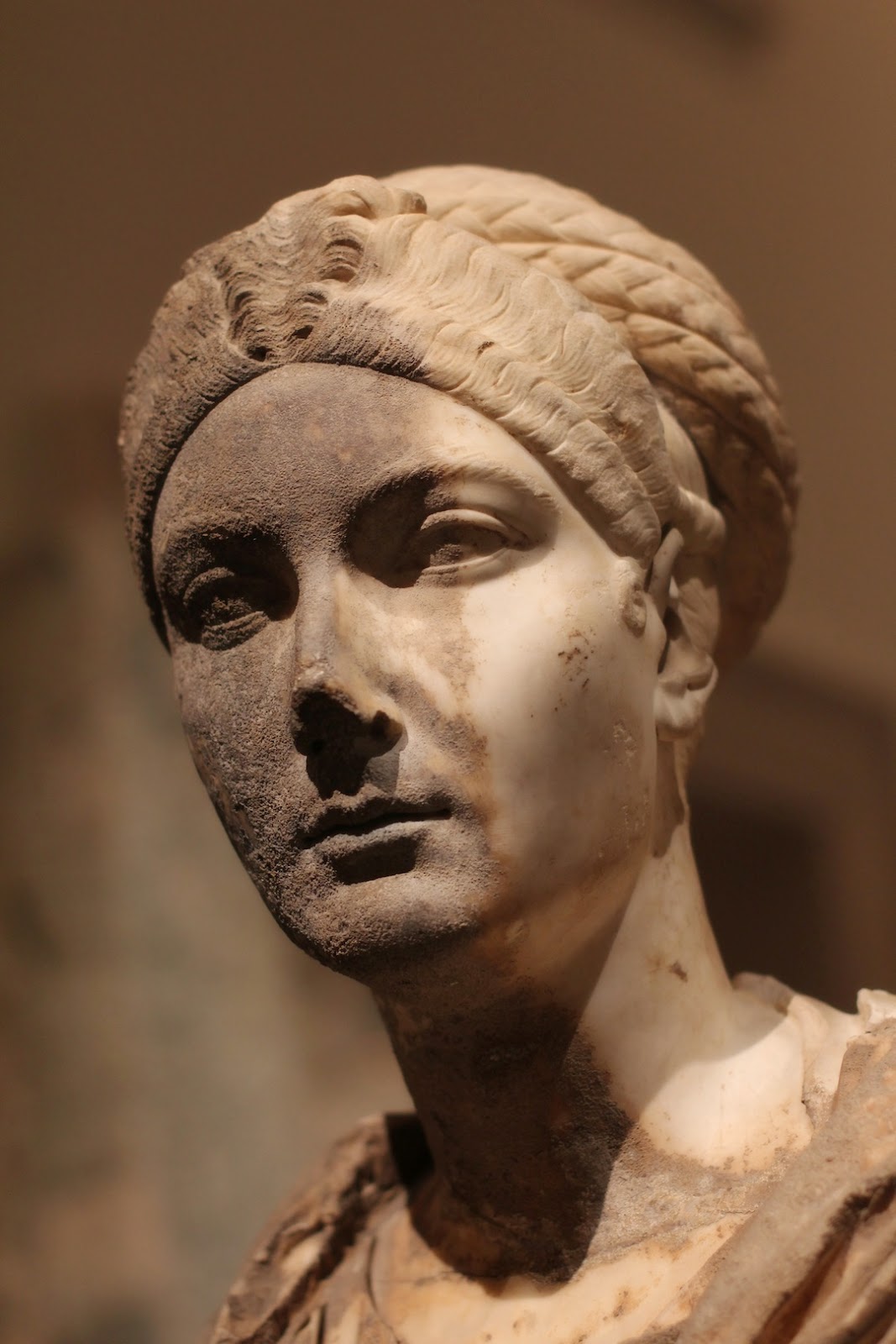
"Marble portrait bust of the Empress Sabina" Roman (ca. A.D. 122-128).
 
Being in the museum at night with such a small group of people was exciting. Besides the bonus of not having to deal with crowds and their accompanying noise, there was the opportunity to see the museum literally in a different light. With no natural light and the electric ones dimmed (at least they seemed that way), shadows appeared and pieces took on a different look. During the day the Sackler Wing, home of the Temple of Dendur and the “Nile," is normally flooded with light from a glass wall but at night in the dark the place becomes more mysterious: the temple seems larger than usual, the "Nile" murkier
(next time they should turn the overheads off completely and have lit torches at the temple entrance—just a suggestion). And I couldn't help but think that being in the Roman Sculpture Court, one of my new favourite spots in the museum, might be a bit unnerving if you were there alone at night (too many empty eyes staring at you). 


Going to an instameet and exploring the museum after dark are two things I'd love to do again. Thank you to the Met and Bloomberg Philanthropies for hosting such a wonderful event.

To see the museum at night, try visiting on Friday or Saturday evenings when the Met stays open until 9 pm. You may not get a private tour but the crowds will be thinner. And to find out what’s going on at the Met, download their new app here.

03 September 2013

Hopper Drawing


Edward Hopper’s works often evoke a sense of isolation, of characters alone in a big city. They are intrinsically American, evocative of a particular place and time in our history. “Hopper Drawing,” a brilliant exhibit at the Whitney Museum of American Art, examines Hopper’s process by looking at the numerous drawings he made including those that served as sketches or studies for his most famous paintings.  

While just 21 finished works are on display there are a couple hundred drawings as well as sketchbook pages. It’s interesting to see Hopper’s vision unfold—a character’s stance changing various times or a location morphing into something quite different from its model. Even a seemingly simple doorway can be seen to switch numerous times. I particularly liked reading his annotations including notes to indicate what colours to use. Hopper's work is often compared to film noir so it’s not surprising to find some of the drawings resembling storyboards as if he was seeing the work in film stills. 

Included in the exhibit are many early drawings by Hopper—dozens of nudes from his student days as well as sketchbook pages from trips to Paris filled with images of café society and various Parisians, including many elaborately made-up women. These drawings may not instantly be recognizable as Hopper but they show a young man finding his own style.


In addition to some wonderful and familiar paintings of New England, many of which are of still recognizable locations, there are some special treats in the exhibit that normally require a plane trip to see.

One of these is Hopper’s legendary “Nighthawks” (1942). Parodied so many times and reprinted on countless postcards and posters, this famed painting is always something of a shock to see in person, as if you almost don’t believe it’s real. There have been countless debates over the exact location that inspired Hopper (it most likely was a combination of a few places) so it’s fascinating to see the evolution of the famed diner take shape in numerous drawings as is the repeated changes to one of the men at the counter. Hopper worked out every aspect on paper; even the coffee urns got their own drawing.


My personal favourite though is “New York Movie” (1939), which shows a female usher waiting for the film to finish. I always like to imagine what the woman is doing. She may be simply listening to the film but I think she's lost in thought, spending the few moments she has to herself before the lights go up. In the exhibit we see 52 different drawings that Hopper made using different city theatres as his inspiration. Over and over again he worked out the columns, the seats, even the usher herself, using Mrs. Hopper as the model.

And speaking of New York, one of the highlights of the exhibit is a piece with just one accompanying drawing. “Early Sunday Morning” (1930) is displayed frameless on an easel, as if Hopper has just walked away. It’s quite effective and reinforces the image of the artist at work.

“Hopper Drawing” is at the Whitney through October 6, 2013. For more information, visit here.

12 December 2012

WWII & NYC

"V-Jay Day in Times Square" Alfred Eisenstaedt (August 14, 1945)

“WWII & NYC” is a great new exhibit at the New York Historical Society that examines the city’s contributions to the war effort and the impact of the war on everyday New Yorkers. The exhibit opens with radio broadcasts by Edward R. Murrow reporting on the London Blitz and then with more than 400 photographs, paintings, and objects, takes visitors through to the end of the war.  

Penn Station, August, 1942. Photo: Library of Congress.

During World War II, New York saw 900,000 of its men join the Armed Services; 18,000 of them would perish. Yet there were many different ways that New York helped to win the war. Perhaps the most important contribution the city made was one that was unknown at the time. The Manhattan Project, started at Columbia University, resulted in the creation of the atomic bomb, which allowed the Allies to gain victory in the Pacific and end the war. On display in the exhibit is a cyclotron (an early atom smasher) that the scientists used; it was borrowed from the Smithsonian where it's been in storage since 1977. 


Minerva Matzkowitz at the Brooklyn Navy Yard. Official U.S. Navy Photo, New-York Historical Society.

New York was a great manufacturer of necessary war items starting with ships built in the Brooklyn Navy Yard, including the Iowa and the Missouri. Also made in New York were uniforms from Brooks Brothers, firearms from IBM-run plants, penicillin from Charles Pfizer & Company, and helmets from the Met that were modelled on ones from the museum's collection. During a time when most materials were commandeered for the war effort, Maidenform received special permission to keep producing bras, an item deemed necessary for the women who took over the workforce stateside. By the way, Maidenform also invented a special “pigeon vest” that resembled a bra for carrier pigeons that were sent behind enemy lines.


Waves on the subway. Photo: New York Historical Society.

The city also served as the largest port of departure for servicemen with 3,300,000 shipping out from New York Harbor (at the height of the war, a ship left every 15 minutes). Meanwhile women trained in the Bronx at Hunter College (now Lehman College) as members of the Women Accepted for Volunteer Emergency Service (“Waves”), which was made a branch of the U.S. Navy. In Queens at an old Paramount movie studio (now the Museum of the Moving Image) soldiers were shown how to become cameramen and films were made for the troops, including one morale booster staring Harold Russell who would go to win an Oscar for The Best Years of Our Lives.

And t
hen there was the effort on the home front from planting victory gardens to hanging service flags in their windows to signify family members serving abroad to dealing with rationing. Many New Yorkers sent care packages to loved ones overseas. One of my favourite items was a sign from Katz's Deli. Concerned with soldiers keeping kosher, it read "Send a Salami to Your Boy in the Army." 

New Yorkers also had to worry about invasion, which wasn’t as far fetched as you might think. In fact, one of the most interesting parts of the exhibit was a section about U-123, a German U-boat that actually sailed into New York Harbor on the night of January 15, 1942. The crew took in the lights of the city (the sailors spoke of seeing the Wonder Wheel at Coney Island) before leaving, sinking a British tanker on their way. 


 Ike is out front to greet visitors. Photo: Michele.

There was much more so if you get a chance I'd suggest spending an afternoon checking out the exhibit. There are film screenings and lectures scheduled as well. “WWII & NYC” runs through May 27, 2013. For more information, visit the exhibit’s site here.

25 October 2012

The Merchant in Mourning


Old houses hold a lot of fascination for me. I love climbing their stairs and peeping into their rooms, imagining the people who lived there before. And so the Merchant’s House Museum in Manhattan is just my type of place—a preserved home from the 1830s that allows visitors a glimpse at what life was like in 19th-century New York.


Built in 1832 in the then fashionable Bond Street area, the Federal-style house was purchased for $18,000 in 1835 by Seabury Tredwell, a well-to-do merchant. His family would live in the home for almost 100 years. Tredwell’s youngest daughter, Gertrude, died there in 1933. Three years later the house was turned into a museum and opened to the public. Today the house, owned by the City of New York and listed on the National Register of Historic Places, is the only 19th-century family home in New York that's been preserved intact.


The house is decorated like it was circa 1835-1865 and filled with original family furnishings including 12 balloon-back chairs, four-poster beds, and gas chandeliers. The Greek Revival design found in the rooms includes Ionic columns in the double parlours and ceiling medallions. There are four floors to explore including the newly opened servants quarters at the top (ironically, they got more light than the other rooms in the house). 


There is also a back garden, which makes for a peaceful place to stop and read the self-guided tour binder or to simply take in the final lingering colours of the season.


I had been to the house before but went the other weekend for a special exhibit—“Death & Mourning in a Mid-19th Century Home”—that recreates the mourning period following Seabury Tredwell’s death on March 7, 1865.

In the house, the curtains were drawn and the mirrors covered with black cloth. The coffin surrounded by lilies (it helped with the smells in those pre-embalming times) was laid out in the front parlour where visitors would come and pay their respects. And upstairs, Tredwell himself was in his bed (the docents give visitors a warning ahead of time; apparently a woman on a previous visit had screamed when she entered the room). Even with the gas lights burning, the room was incredibly dark with everything covered up. I can only imagine how cold and somber it must have felt at the time.


The exhibit runs through November 5. To really get into the spirit this month, there are candlelight ghost tours and a reenactment of Tredwell's funeral on October 30, which culminates with his coffin being carried to the nearby New York City Marble Cemetery. For more information, check the museum's site here.

Photos by Michele.

17 October 2012

The Power of Words


Mr. Morgan's Library. Photo: Michele.

A few weeks ago I spent an afternoon at a favourite place in the city—The Morgan Library & Museum. First opened to the public in 1924, the Morgan began as the personal library of financier J.P. Morgan who hired the renowned firm of McKim, Mead & White to build the beautiful Italian Renaissance-style building next to his Madison Avenue home in 1902. Among the thousands of items in the Morgan collection today are not one but three Gutenberg Bibles, The Hours of Anne of Cleves prayer book (gorgeous), Beethoven and Mozart manuscripts with handwritten notes, Jane Austen’s letters, concept drawings for Antoine de Saint-Exupery’s The Little Prince, and first drafts of Bob Dylan lyrics.

I think my favourite section of the museum is Mr. Morgan’s Library, a wonderful large room with an enormous fireplace and tapestry and shelf after shelf of leather-bound books that rise up to a vividly painting ceiling. Wouldn't it be great to have that place to yourself and just sit and read?

The purpose of this visit was to see a special exhibit, “Churchill: The Power of Words,” which explored the famed prime minister’s masterly use of the English language. Apparently JP Morgan was a friend of Churchill’s mother, the Brooklyn-born Jennie Jerome Churchill, so it only seems fitting that an exhibit of Churchill items rarely seen outside the UK would be at the Morgan. I went the day before it closed and am so happy I didn't miss it.

While most people think of Churchill as a politician, many forget that he was a prolific writer; one of his first jobs was as a journalist, and he wrote numerous books. The exhibit included examples of Churchill’s writings from early letters written as a child to his mother from boarding school to an unpublished manuscript on the art of rhetoric to speeches he gave to the House of Commons to his stirring radio addresses that helped Britain stay the course.

A special focus of the exhibit was on Churchill’s relationship with America, particularly his strong friendship with Franklin D. Roosevelt. The two men liked each other tremendously and appeared to have enjoyed each other’s company, evidenced by their warm banter. Roosevelt once told him “it’s fun being in the same decade as you.”

There were also personal items of note to see—Churchill’s Nobel Prize for Literature, his US passport (he was made an honorary American citizen), a painting he did of Cap d’Antibes, and a noiseless typewriter that Churchill insisted his secretaries use so he would not be distracted by the clacking of keys while giving dictation.

Not all of the words in the exhibit came from Churchill. A very personal letter from King George VI (“My dear Winston,” it begins) after the death of Roosevelt was included as was a hilarious note from his doctor who prescribed alcohol for Churchill after he was hit by a car during a visit to Prohibition New York in 1931. Perhaps my favourite non-Churchill lines were the shortest. When war was declared on September 3, 1939, Churchill was appointed First Lord of the Admiralty and a signal was sent to the fleet that simply said “Winston is back.”

An annotated draft of Churchill's September 11, 1940 speech. Photo: Churchill Archives Centre, Cambridge.

Yet with all of the material to read and look at, it was the drafts and final copies of his speeches that remained a highlight of the exhibit. Those stirring words that we have all heard recordings of were there in black and white, some with handwritten notes correcting a word or fact, some appearing like a poem on the page. Final, clean copies showed long spacing between certain words—a reminder to Churchill to pause when speaking.

Recordings of some of his most noted wartime addresses were played in a small portable theatre while images and the words were shown on video screens. The audio may have been scratchy but that unmistakable voice was there, speaking words that still manage to stir up emotions and proving why Churchill was one of the great wordsmiths of his time. Here is just one example:

“Hitler knows that he will have to break us in this Island or lose the war. If we can stand up to him, all Europe may be free and the life of the world may move forward into broad, sunlit uplands. But if we fail, then the whole world, including the United States, including all that we have known and cared for, will sink into the abyss of a new Dark Age made more sinister, and perhaps more protracted, by the lights of perverted science.
“Let us therefore brace ourselves to our duties, and so bear ourselves that if the British Empire and its Commonwealth last for a thousand years, men will still say, 'This was their finest hour.'”

To find out more about the Morgan Library & Museum, visit their site here. For more on Churchill, visit the Churchill Centre and Museum’s site here.

04 September 2012

A Neue Saturday


"Portrait of Adele Bloch-Bauer I" Gustav Klimt (1907)


One Saturday this summer I met up with a friend on the Upper East Side to go to an event only to discover that it was happening on a different day (I must learn to double check these things). What to do? With a free afternoon on our hands, we decided to head over to the Neue Galerie.

I quite like the Neue. The building is lovely, their collection small but excellent, and the special exhibits are always interesting. Having a café that serves divine cakes doesn't hurt either.

This year marks the 150th birthday of Gustav Klimt so the museum was celebrating with an exhibit of related photographs and drawings in addition to the paintings from their permanent collection including its star, Adele Bloch-Bauer I (1907). No reproduction in a book or poster can do justice to the painting's amazing golds.

"Anna with Mirror" Heinrich Kuehn (1902)

Yet it was an exhibit on another floor that really captured my attention. “Heinrich Kuehn and His American Circle: Alfred Stieglitz and Edward Steichen” looked at the work of Austrian photography pioneer Heinrich Kuehn (1866-1944) and his friendship with the leading American photographers. Kuehn believed early on that photography was an art form and at the turn of the century became an influential member of the Pictorialist movement that emphasized beauty over realism in photography.

Alfred Stieglitz would become Kuehn’s advocate and in 1906 exhibited Kuehn's work at his New York Gallery (a section of which was recreated at the Neue). The two would correspond for more than 30 years and along with Edward Steichen explore new photography techniques. Yet Kuehn never achieved the status that the American photographers did. 

The photographs in the exhibit were dreamlike and striking. I was particularly taken by the ones printed with the gum-bichromate process on textured paper, which gave them the look of a painting. Along with Tyrolean landscapes were many images of his four children and their nanny, Mary Warner, who would often pose for him and is believed to have become Kuehn's companion after the death of his wife.

"Still-life with Violets" Heinrich Kuehn (ca. 1908)

But the most stunning photographs were to be found in a short film screened in one of the rooms. Using autochrome, an early form of colour photography, Kuehn managed to capture striking colour images like this bunch of violets. They were incredibly beautiful. Unfortunately, these images are now so fragile they can no longer be displayed.

Afterwards we browsed the gift shop and enjoyed a delicious lunch at Café Sabarsky. I had Spätzle and Früchte Eistee (fruit ice tea) and somehow managed to keep away from the cakes for once. All in all, not bad for a Plan B.

To find out more about the Neue Galerie, visit their website here.

26 July 2012

Murder Is My Business

Weegee shooting outside his studio (ca. 1939).

With the winning combination of photography, true crime, and New York, the International Center for Photography (ICP) exhibit “Weegee: Murder Is My Business” was bound to be a favourite of mine this summer. And after a recent viewing, I’m happy to report it didn’t disappoint.

Arthur Fellig (1899-1968), who immigrated to New York as a young boy, worked in a variety of photography-related jobs from photographer’s assistant to darkroom technician before striking out on his own as a freelance photographer. Nicknamed Weegee after the Ouija board for his uncanny ability to get to the scene right before a crime occurred, he become one of the best-known photographers in New York. With his trademark cigar in mouth and Speed Graphic camera in hand Weegee ushered in what would become known as tabloid journalism.

The ICP exhibit focuses on the years 1935-1946 when Weegee was at the height of his fame. During this time, he lived across the street from Police Headquarters in a tiny cold-water studio with just the bare minimums—a single bed, a beat-up desk, a police radio. His studio is partially recreated in the exhibit, which along with his camera, oversized press badge, and hat on display help to bring to life the man behind the photos.

"Mr. Esposito in line for night court" Weegee (January 16, 1941).

Weegee strove to beat the police to the scene of a crime and to see his photos printed first. To facilitate this need, he drove a 1938 Chevy Coupe, which acted as an office on wheels. Outfitted with a police radio, it included a portable dark room, typewriter, and change of clothes (along with a supply of cigars), allowing Weegee to get his photos and copy (he often wrote his own captions) to the Daily News, Herald-Tribune, Journal-American, PM, Post, Sun, or World-Telegram before his competition. Always aware of his public image, he didn't shy away from getting his own face in the papers and took to stamping his photos “Weegee the Famous.” In 1945, he published many of his images and prose in a book, Naked City, which became a bestseller.

Weegee’s beat was the streets of New York. In particular, the streets at night (that's when murder happened). And with his blinding bright flash, he captured New York in all its grimy realism. Murder suspects hide their faces, children stare right at the camera, fires blaze, cops go about their business. In one image, candy-store owner Joseph Gallichio lays dead while his neighbours look on. In another image, a pristine white hat sits upright near the head of its murdered owner, Dominic Didato. Yet there is also humour to be found in some of the images. In one section, cross-dressing men descend from the back of a police wagon, smiling and posing for the camera like models on a runway.

"Their First Murder" Weegee (October 9, 1941). 

Part of the exhibit is devoted to Weegee’s show at the Photo League in 1941 (the title for this exhibit comes from that show). Weegee’s homemade displays are recreated including the use of red nail polish on the white board to mimic blood (Weegee’s idea). The guest books from the 1941 show make for great reading; one visitor complains about the unprofessional quality of the displays while another innocently asks how one can become a Weegee.

Yet crime wasn’t the only topic that interested Weegee. Toward the end of the exhibit visitors can watch some color footage of people at Coney Island that he shot in 1948. The colour lends a modern air to the people playing and laughing on the beach and proves that murder was not Weegee's only business.

The exhibit is at the ICP through September 2, 2012. For more information, visit their website here.

06 June 2012

Mrs. Parker Goes to Washington

The Capitol Dome.

Last weekend I headed down to Washington, DC to visit some dear friends from grad school. And oh what a beautiful weekend it was. After torrential rains the day before, the skies were blue and the air was dry for my entire visit so we spent a lot of the time outdoors.

The artillery section of the Ulysses S. Grant Memorial.

The U.S. Botanical Garden.

Inside the conservatory.

Just one of the many orchids on display.

Ducks in the pond!

Roses in the park.

Saturday, after checking out the Ulysses S. Grant Memorial, we headed over to the U.S. Botanical Garden. Inside the large conservatory we saw plants from around the country and a special exhibit on carnivorous plants. Most impressive was the section on orchids. Outside we strolled through the adjoining National Garden and Bartholdi Park where a mama duck and her growing babies were hanging out in a small pond while the roses nearby perfumed the air.

The National Cathedral.

A brilliant blue sky.

A detail from one of the Cathedral gates.

The Bishop's Garden.

Lush Magnolias in the garden.

That afternoon we trekked up to the National Cathedral. Although still showing damage from last year’s earthquake, it’s an incredibly impressive building complete with gargoyles and stained glass windows that add a touch of the Gothic to the city. We tried to spot the Darth Vader gargoyle (unfortunately you need binoculars) before walking through the grounds designed by Frederick Law Olmsted, Jr. The Bishop’s Garden with its stone paths, rose and herb gardens, and benches made for sitting with a book was perfectly lovely.

After a leisurely brunch on Sunday, we decided to visit the National Museum of Women in the Arts. Located in a pretty Renaissance Revival style building, it’s a perfect sized museum to wile away a few hours.

"Melancholy" Constance Marie Charpentier (1801)

On view was “Royalists to Romantics: Women Artists from the Louvre, Versailles, and Other French National Collections.” Charting the history of French women artists from the court of Louis XVI and Marie Antoinette to the restoration of the monarchy (with the revolution and Napoleon in-between), the exhibit is a fascinating insight into the challenges women artists faced at the time. Many came from aristocratic or artistic families who had to use their connections to get them into schools where they were not given the same instruction as their male counterparts (for example, women were not allowed to sketch nude models). And most had to fight to be recognized as artists. Prior to the Revolution, the prestigious French Academy only accepted four women. After the Revolution, women's rights disappeared (so much for égalité) and their number at the Academy dropped to zero.

"Portrait of a Woman" Adélaïde Labille-Guiard (1787)

Although the majority of the exhibit is comprised of paintings, one of my favourite pieces was a letter opener (I thought it was a dagger at first glance) by Félicie de Fauveau depicting Romeo climbing up to Juliet on her balcony. I also quite liked Adélaïde Labille-Guiard's "Portrait of a Woman." Although a supporter of the Revolution, she was a painter of Royal portraits and was asked to destroy some of her work, which must have been devastating. 

With a few exceptions, like Élisabeth Louise Vigée-LeBrun, a favourite of Marie Antoinette, most of the 35 artists in the exhibit are largely unknown and this exhibit is the first time that many of their work has been seen outside France. That alone made the exhibit worth viewing. “Royalists to Romantics" runs until July 29, 2012. For more information, visit the museum's website here.

That evening I was on the train back to New York, tired and a bit red from the sun. I'm already looking forward to my next visit.

All photos, except for the ones of the paintings, by Michele.

LinkWithin

Related Posts Plugin for WordPress, Blogger...