12 June 2013

Punk: Chaos to Couture

Dress by Karl Lagerfeld for House of Chanel, Vogue, March 2011

"God save the queen. The fascist regime." Sorry, but when I heard that the Met was going to have an exhibit on punk I couldn't help but start singing "God Save the Queen" by the Sex Pistols. I may never have been a punk but I've definitely listened to a lot of the music.

Which is why I was happy to see the exhibit "Punk: Chaos to Couture" with a dear friend who I've known since middle school who is also a fan of the music. She went with me to see the Alexander McQueen exhibit a few years ago, which was so brilliantly executed that it raised the bar high for future fashion exhibits. 

Unfortunately this one didn't come close. The exhibit starts off well enough with the birth of punk in New York and London represented by recreations of two legendary punk locations—the bathroom at CBGB in New York where Patti Smith said "all the action happened" and Malcolm McLaren and Vivienne Westwood's Seditionaries shop in London where they sold their infamous t-shirts (some of which are on display) and other bondage-based clothes. There were videos along with music blaring to help set the mood (this was repeated in each gallery; I was happy to hear the Clash in one).


Two Gianni Versace dresses, spring/summer 1994. The one on the left is the safety pin dress made famous by Elizabeth Hurley.


From there the rest of the exhibit is devoted to couture's adoption of punk or punk elements, which after the first round of gowns gets a bit boring. There are plenty of safety pins, studs, plaid, and ripped material to show a connection to punk but how punk can a dress be that costs more than my rent? Some of the more memorable items among the almost 100 on display are Versace's notorious safety pin dress worn by Elizabeth Hurley, a heavily studded black leather jacket by Christopher Bailey for Burberry, a particularly lovely black gown by Moschino decorated with tiny safety pins and rings, Gareth Pugh's black trash bag dresses that look like feathers from afar, Maison Martin Margiela's minimal dresses made out of plastic bags complete with original handles, and McQueen's spray-paint dress. But those items can't quite save the exhibit. Better luck next time, Met.

"Punk: Chaos to Couture" is at the Met through August 14, 2013. For more info visit here. All images from the Met.

11 June 2013

The Fall


Last weekend I stayed up late watching The Fall, a BBC program that I had been dying to see (no pun intended).

The murder of a young woman has the police in Belfast stumped so they call in DSI Stella Gibson from the Met in London who quickly sees connections between this murder and prior one. The police at first are reluctant to agree (this might mean they messed up) yet when a similar murder occurs it becomes apparent that they have a serial killer on their hands, one who stalks and preys on young career women. Gibson takes over the investigation and sets about drawing the murderer out before he can kill again.

The main reason I was excited for The Fall is that Gillian Anderson plays Gibson. Yes, Dana Scully of the X-Files is once again donning a lanyard and carrying a gun. I don’t mean to sound glib. Anderson is a fantastic actress. It’s just hard not to think of Scully when she’s in a police tale, especially when she visits the morgue.

Gibson is a type of character popular in mysteries: the single female detective who is intelligent, attractive, lives alone, and appears to need nothing but her job save for the occasional one night stand. It’s been done many times before (think Cordelia Grey in the PD James novels or DCI Jane Tennison in Prime Suspect as a couple of classic examples), and you can now add Anderson’s Gibson to the list.

A good detective and leader, Gibson manages to run a team smoothly. She gives commands without raising her voice, holds her own with the men, and supports the career advances of younger female officers. She is utterly devoted to a case. She lives the job, drinking too much coffee, changing in the women’s room, and even spending some nights on a cot in her office.


She is also attractive and uses it to her advantage, lowering her voice and speaking softly, flipping her long blonde hair, and wearing shirts that almost reveal too much. In fact, her wardrobe is one of the standouts on the show: silk shirts with black pencil skirts and trousers, heels and tailored coats. She always appears put together, a bit posh. It’s only in the close-ups that she allows the fatigue she’s feeling to show in her eyes.

And Gibson is used to getting what she wants. Spotting a good-looking police officer, she asks to be introduced and almost immediately tells him where she’s staying and her room number. For her it’s sex with no strings attached, something that she refers to as “sweet night,” a term borrowed from an African tribe. Gibson knows this because her first degree was in anthropology, one of the few personal details she reveals about herself.

The other cast members are stellar including Jamie Dornan as Paul Spector, a family man and grief counsellor who happens to be a serial killer, John Lynch as ACC Jim Burns who has a history with Gibson, and Niamh McGready as Danielle Ferrington, the young patrol officer who becomes Gibson’s right hand woman.

All five episodes are streaming now on Netflix and the BBC has commissioned a second season (yay!). Watch them all but a word of advice: start your viewing early in the evening, as you’ll want to blast right through all five.

10 June 2013

The Donut Pub


For the last few years in New York the word on the street (I can’t believe I just used that phrase) has been that the donut was the new cupcake, which means that more places have started selling donuts, many with ridiculous flavours (hibiscus donut, anyone?) and at high prices. 

Yet there are some things that don’t need fiddling with and the donut is one of them. It’s really quite simple—donuts should come in a few traditional flavours and should be cheap. And the best donuts in New York can be found at the Donut Pub. Now there are some who might disagree with me on this and that’s fine, they’re welcome to their opinion. But hear me out.


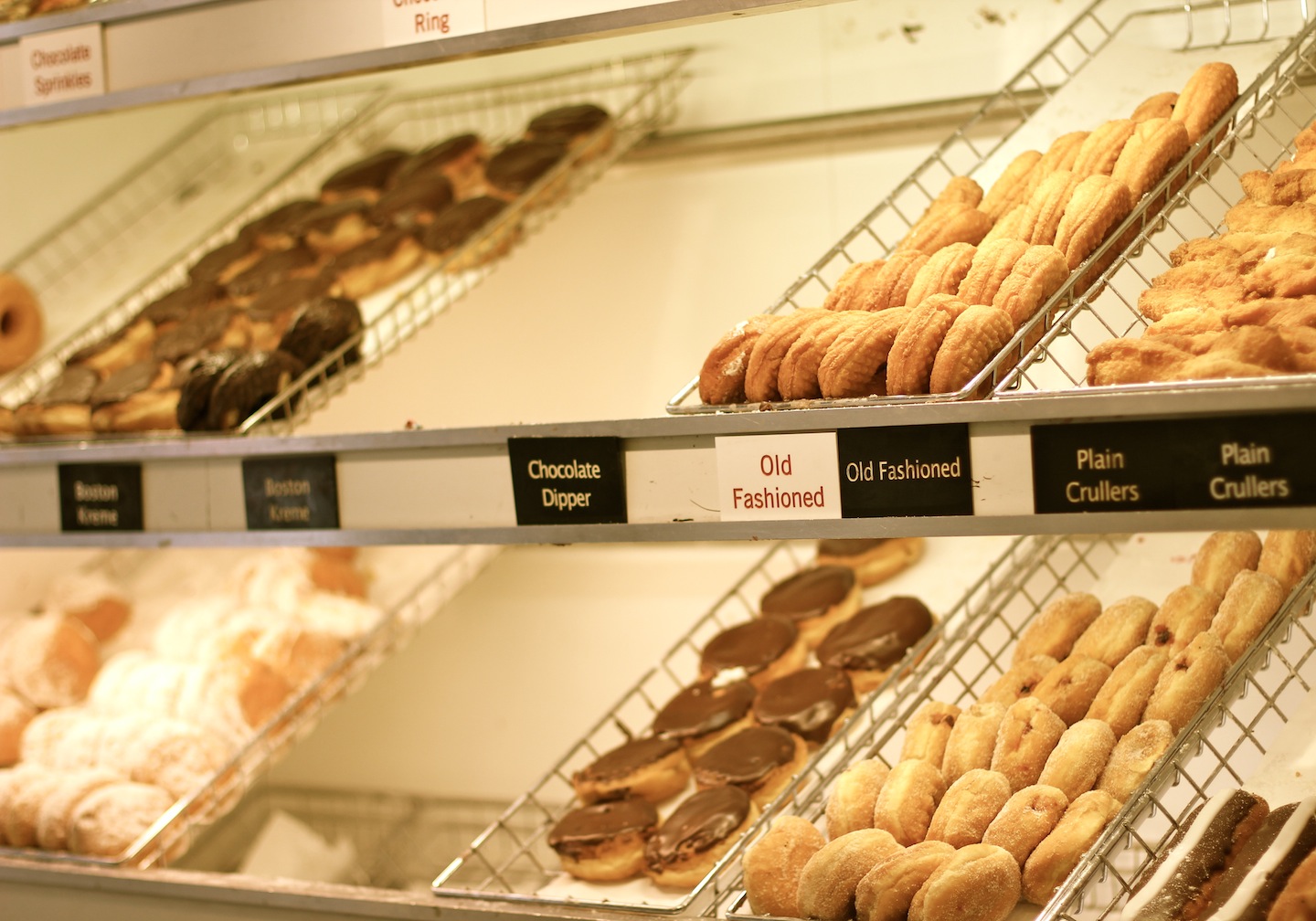
The Donut Pub has been in business since 1964. They are open 24 hours, seven days a week, and sell traditional donuts—rings, old fashioned, filled, and crullers—in the usual glazed, chocolate, sugar, jelly, and a few other flavors (the red velvet appears to be their nod to trends) along with other sweets and bagels. You can grab a stool and sit at the counter or get yours to go (if you do and order a coffee, they'll put it in your bag along with your donut, a sign that you’re in a real New York joint). A chocolate ring and coffee will set you back less than $3. And if that weren’t enough, the owner’s name is Buzzy. What more could you want in a donut shop?

The Donut Pub is located in Chelsea near the corner of West 14th Street and Seventh Avenue. For more information, check out their site here.

Photos by Michele. Sorry there aren't more donut close-ups. I was only able to take a few quick shots inside and meant to take one of my chocolate ring that I got to go but it, uh, didn't last long enough.

07 June 2013

Rainy Friday


Today is the anniversary of both Jean Harlow and Dorothy Parker's deaths (June 7, 1937 and June 7, 1967, respectively) and it's been raining buckets all day, which seems appropriate for the occasion. But rather than end the day on a sad note, let's turn our thoughts to something more pleasant. Here is Gene Kelly in the classic scene from Singing in the Rain (1952), made only more brilliant when you learn that on the first day of filming Kelly was sick with a fever but still managed to dance his heart out. So if it's raining where you are remember to "walk down the lane with a happy refrain." Have a wonderful weekend, everyone!

05 June 2013

Mary Gets a Bob


Everyone knows I’m a fan of the bobbed haircut (I sport one myself). So I was of course intrigued when I came across this image of silent screen star Mary Thurman. Especially when I discovered that she was a Sennett bathing beauty who normally wore curls.

She was born Mary Mervonian Christiansen (nickname Von) on April 27, 1893 in Richfield, Utah. College educated (a rarity for actresses), she received a degree from the University of Utah and became a schoolteacher. She also became a wife, marrying Victor Thurman, the son of Utah Supreme Court Justice S. R. Thurman (they would later divorce in 1919). 

A trip to California in 1915 changed her career and life when her good looks got her the attention of a talent scout. She had two uncredited parts in the Douglas Fairbanks vehicles The Lamb and Double Trouble but it was the approval of Mack Sennett that was her real break.


Mary became one of Sennett’s famed bathing beauties, primping for the camera along side other lovelies usually at the seaside. For the next three years she also stared in a series of Sennett produced comedy shorts, often with Sennett stalwart Charles Murray.


In 1919 she moved up to features, starring in the unfortunately titled The Poor Boob for Famous Players-Lasky. She would go on to make 35 more films and work with the likes of Mae Murray, Gloria Swanson, Betty Compson, Richard Barthelmess, Tyrone Power Sr., and Harrison Ford.


One of her better films was Sand (1920) with legendary cowboy William S. Hart who chose the script personally. In it Mary plays the love interest of Hart, a railroad station agent who after being falsely fired by his rival for her affection must capture a gang of bandits to redeem himself. The film is pretty good including some strong performances and great on-location shots. You can watch the entire film here.

Another important film of Mary's was one that her fans at the time never saw. Leap Year (1921) stared the popular comedian Fatty Arbuckle who plays the heir to a large fortune, which draws the attention of attractive women who distract him from the woman he’s in love with, his uncle's nurse played by Thurman. Unfortunately, filming finished right before Arbuckle’s infamous trip to San Francisco that resulted in the comedian being charged with the rape and murder of actress Virginia Rappe (he was later acquitted). Leap Year was subsequently banned and didn't see a release until 1981.


One of the other noteworthy tidbits about this film is that Mary appears in it with a sleek, straight bob, a look normally associated with Louise Brooks. In an interview with Adela Rogers St. Johns, Mary explained her new look saying that she had gotten her hair wet at the beach, which flattening her curls, and that her friends had told her it looked good and she should wear it that way. Normally pictured with a head of chestnut curls the new hairstyle, which Mary added bangs to, altered her appearance (her face even looks different) and gave her a classic flapper look.


The hairstyle made a big impact. One illustrator was inspired to capture the new look with a result that screams 1920s, right down to the bee-stung lips, while famed photographer Alfred Cheney Johnson saw her as the French Dauphin (or maybe he had Joan of Arc on the mind). 


Mary continued to work steadily, proving to be at home in both comedies and dramas. In 1925 she travelled to Florida to film Down Upon the Suwanee River. In it she plays a young woman who faces condemnation for giving birth out of wedlock although she really is married to a man who has been run out of town for espousing Atheism. All is well though when he finds God and returns home to wife and baby.

But all was not well for Mary. During filming she contracted malaria. She became deathly ill and retreated to New York where her friend and former Sennett Bathing Beauty, Juanita Hansen, took care of her. Mary never recovered though and after contracting pneumonia died on December 22, 1925. She is buried in Utah.

I'd like to find out more about Mary and watch some of her other films like Leap Year. And all because of a picture of a woman with a bob that caught my attention.

03 June 2013

The Lovely Ollie


The other day, I wrote a post about actress Peggy O'Neil. It was a photo that I had stumbled upon that prompted me to find out more about her. This happens all the time. I'll see a photo whose subject strikes me in some way but I won't know anything about them. So in addition to my usual posts about exhibits, film, and New York going-ons, I think I'm going to write more posts about these images. Sometimes it may be a healthy amount of information about the person, like with Peggy O'Neil, while other times there may be very little, like my post about Rosaline Courtneidge. Regardless, I hope you'll enjoy finding out, along with me, the story behind the people in the photos.

In the meantime, here is a photo of a woman I know a lot about—Olive Thomas. This is a new photo for me, which I discovered the other day in the J. Willis Sayre collection at the University of Washington. The date on the photo is 1919, the year that saw the release of eight films with Ollie, including Toton, the film of hers that I would most like to see (it's now presumed lost). The following year she would be dead in Paris at the age of 25. To learn more about Ollie, you can read my posts here and here. Otherwise, look for more behind the photo posts soon.

01 June 2013

Hello, June


June has arrived and with comes the start of my least favourite season in New York. It's already hit 90 this week, and I think we're going to be in for a long, hot summer. Don't get me wrong. I don't mind the heat if I can be at the beach but summer in the city is just sticky, smelly, and downright uncomfortable. On the upside, June means I can pull out my bottle of Pimm's and start making one of my favourite summer drinks. Cheers, June.

Isn't this image from the cover of Vanity Fair adorable? You can purchase a phone cover with it from here.

LinkWithin

Related Posts Plugin for WordPress, Blogger...